


Why Good Projects Start Getting Weird: Improving Communication Between the Field and Office
Lately, when I’ve been facilitating Partnering sessions, one of the most common issues project teams bring up is improving communication between the field and the office. It’s a big one and tends to be neglected, so I decided to dig into it this month.
Every construction project has two versions of reality:
- The one in the trailer (clean, organized, nicely labeled PDFs)
- The one in the field (mud, noise, changing conditions, and “we had to deal with it”)
And when those two versions stop lining up… things get interesting. Not in a fun way. More like:
- “Wait, who approved that?”
- “Why is this here already?”
- “Why are we doing this twice?”
Sound familiar? It does to many of the teams I support. Why? Because the field moves fast and the office thinks ahead. If they’re not connected, the project lives in two different timelines.
Where Communication Usually Goes Off the Rails
Here are a few examples of how project team communication breaks down:
The “Oh Yeah, We Talked About That” Problem: A decision gets made, during a site walk, in a quick huddle, or leaning on a pickup truck…and then disappears into the void. Then three weeks later the Office is saying, “We never approved that,” and the Field is saying, “We definitely talked about it.”
The Time Warp: The field adjusts something at 9:00 AM. The office finds out at 4:30 PM… maybe. Decisions made in the office are already outdated before they’re sent. It’s like steering a boat by looking at where the water used to be.
The “Too Many Ways to Communicate” Problem: You’ve got texts, emails, software, marked-up drawings, radio chatter, and memory (always a classic) Everyone is communicating but no one is aligned.
The Classic “We’ll Fix it Later”: The field keeps moving (because, of course, they have to). Documentation? That’s a “we’ll catch up later” task. But “later” means you reconcile the issue months after the fact… or never at all.
Communication problems don’t stay in their lane. Scheduling gets fuzzy, costs creep up, subs get stacked, quality gets inconsistent, and owners lose confidence. It spreads faster than anyone expects because communication usually isn’t designed – it’s assumed. And on busy projects communication becomes accidental instead of intentional.
What Helps Teams Stay Aligned
- Don’t let decisions float in the air. Quick convo? Fine. But document your agreement somewhere visible and agree where it will be captured. Immediately.
- Sync Daily. Even a 10-minute huddle changes everything: “What changed?” “What’s risky?” “What does everyone need to know today?”
- Make it easy for the field. If it takes 10 clicks and a password reset… it’s not happening.
- Act like one team. The second it becomes “field vs office” or “owner vs contractor” communication shuts down.
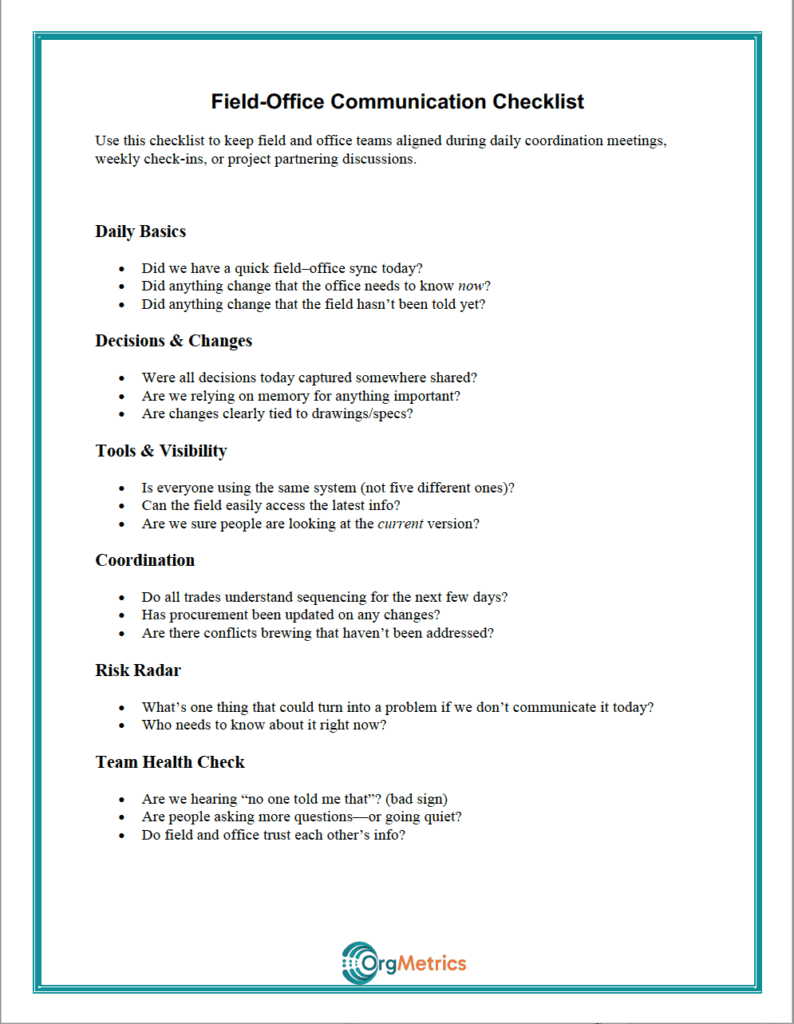
- Use this Field-Office Communication Checklist. Print it. Use it. Adjust it. But actually use it.
Good communication on a construction project isn’t about talking more. It’s about making sure the right people know the right things at the right time in a way they can actually use. Projects rarely fall apart because something went wrong. They fall apart because people didn’t know about it soon enough to fix it.
~ Kate
Kate Stewart’s distinguished career spans 25 years as a professional neutral and organizational development consultant for numerous large organizations. Her expertise includes Partnering facilitation on high-profile projects, such as the Kansas City International Airport mega program. She has served as a coach, trainer, researcher, and thought leader across various industries and disciplines on both domestic and international fronts. Kate is based in the picturesque Paradise Valley, Montana, where she enjoys hiking, gardening, and reading.
For more information, please contact Kate Stewart, katestewart@orgmet.com / (406) 414-9922 (cell) or OrgMetrics RobReaugh@Orgmet.com / (925)449-8300