


If You Can’t See the Bottom, Don’t Start Running: Why Clarity Drives Project Success
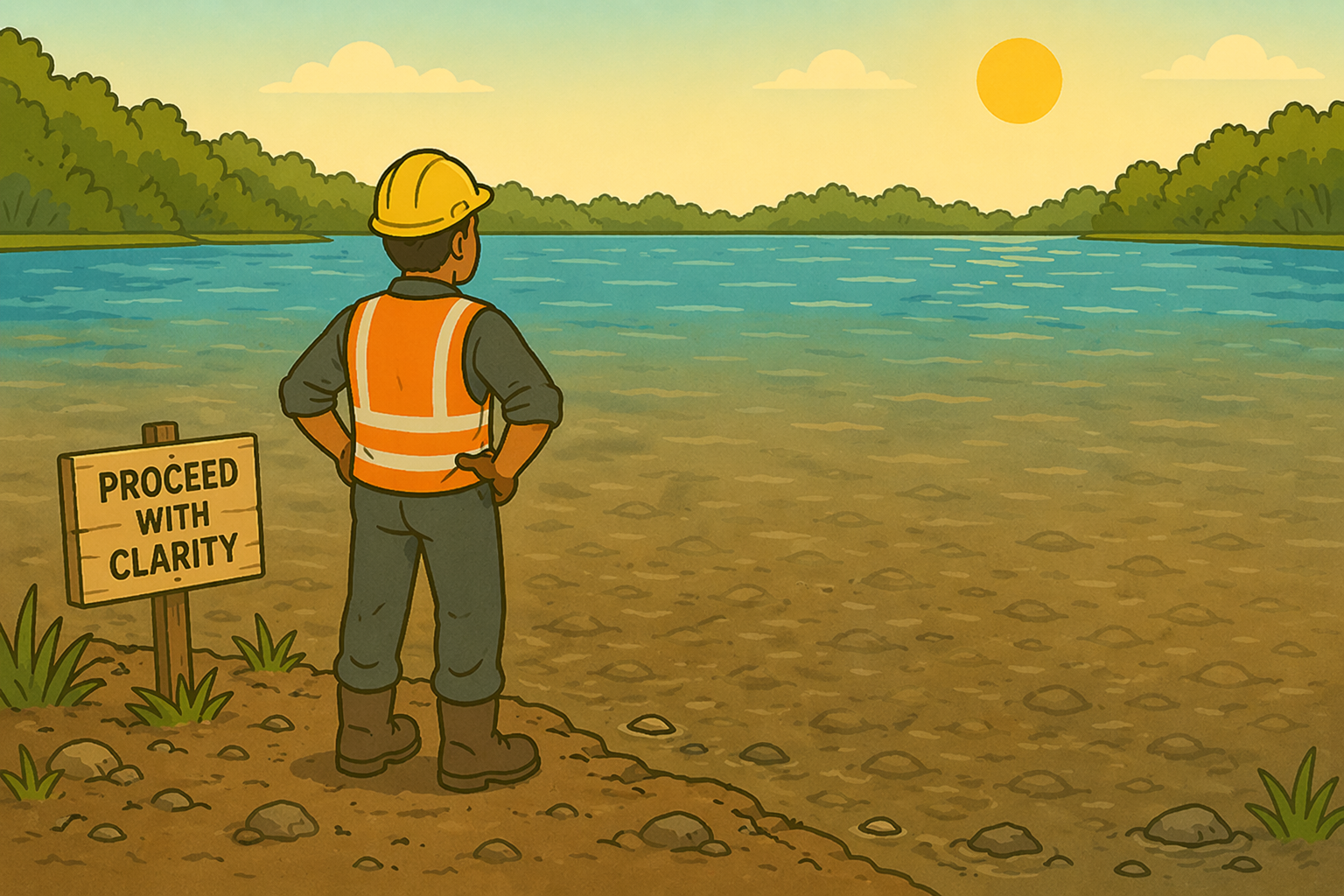
Picture this: you walk down to a lake on a calm morning. The surface looks fine. Peaceful… inviting even. But when you step in, the water is murky. You can’t see your feet. You don’t know where the rocks are, how deep it drops off, or what you’re about to step on. So you shuffle forward slowly, arms out, testing every step. You wouldn’t sprint into that lake, and yet, that’s exactly how many construction projects are run.
When clarity is missing, teams move cautiously, make assumptions, and react instead of plan. The schedule slips, the budget flexes, and everyone wonders how things got so complicated.
Clarity is what lets a project move forward confidently—without constantly feeling around for hidden hazards.
Clarity of Roles & Responsibilities: Who’s Watching the Shore?
On unclear projects, everyone is working—but not always on the right things.
Without clear roles:
- Decisions stall because no one knows who owns them
- Tasks get duplicated or skipped entirely
- Accountability gets fuzzy fast
When roles aren’t crystal clear, two bad things happen:
- Work gets duplicated (“I thought you were handling that.”)
- Work falls through the cracks (“Oh… I assumed someone else owned it.”)
Clear roles answer a simple but critical question: “Who is responsible for making sure this actually happens?”
When that answer is obvious, rework is reduced, finger‑pointing doesn’t happen, and team members don’t use the magical thinking that problems will solve themselves. Issues surface earlier and problems get solved faster.
Clarity of Mission: Rowing in the Same Direction
Every team says they want the project to succeed. The problem is that “success” can mean very different things to different groups. If the mission isn’t clearly defined:
- Design optimizes one priority
- The field optimizes another
- Management focuses on something else entirely
Some may think success is finishing early, others think it means meeting the budget, others think it’s avoiding change orders, others see it as prioritizing safety over everything, and others protecting quality at all costs. Soon, silos form. Everyone is rowing hard—but not in the same direction.
A clear mission, and aligned understanding of that mission, enables the entire team to move across the lake together, instead of circling it.
Clarity of Expectations: No Sudden Drop-Offs
Unclear expectations are like unexpected deep spots—you don’t see them until you’re in trouble.
Schedules, quality standards, response times, and approval levels all need to be stated plainly and in advance. When they aren’t, people fill in the blanks with their own experience.
And that leads to the phrase that haunts projects everywhere:
“That’s not what I thought you meant.”
Clear expectations turn confusion into alignment—and surprises into planning.
Clarity of Communication & Information: It’s About What’s Understood
Here’s the truth: Clarity isn’t about what you said. It’s about what the other person understood. Research from the Project Management Institute consistently shows that communication and clarity are among the leading factors in project success. Construction teams are made up of different disciplines, vocabularies, and perspectives. Words like “complete,” “temporary,” or “approved” don’t mean the same thing to everyone. Assuming shared understanding feels efficient—but it’s risky.
When Clarity Is Missing, Assumptions Take Over
When the water’s cloudy, assumptions rule:
- “They know what I meant.”
- “This is standard.”
- “We’ll figure it out later.”
Assumptions lead directly to:
- Rework
- RFIs
- Delays
- Budget overruns
- Difficult relationships
Projects rarely fail because people don’t care. They fail because people assumed they were aligned when they weren’t.

Clear Water Builds Confident Teams
When clarity is present:
- People move faster and with confidence
- Decisions stick
- Risks are visible early
- Trust and confidence increase
The team stops shuffling and starts moving.
So when a project feels slow, tense, or more expensive than it should, ask:
- Are roles unmistakably clear?
- Is the mission shared—or just assumed?
- Have expectations actually been stated?
- Has understanding been confirmed?
Because no one performs well in murky water. And no construction project hits its budget and schedule without clarity.
If you can see what’s under the surface, you can move forward without fear.
~ Kate

Kate Stewart’s distinguished career spans 25 years as a professional neutral and organizational development consultant for numerous large organizations. Her expertise includes Partnering facilitation on high-profile projects, such as the Kansas City International Airport mega program. She has served as a coach, trainer, researcher, and thought leader across various industries and disciplines on both domestic and international fronts. Kate is based in the picturesque Paradise Valley, Montana, where she enjoys hiking, gardening, and reading.
For more information, please contact Kate Stewart, katestewart@orgmet.com / (406) 414-9922 (cell) or OrgMetrics RobReaugh@Orgmet.com / (925)449-8300