


The 4 Forces You Can’t Afford to Ignore on Construction Projects—And How to Master Them
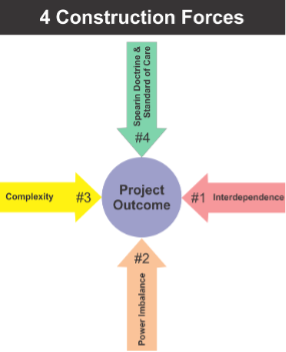
Today’s construction projects are more ambitious than ever, with high stakes, tight schedules, and a complex team-of-teams involving dozens to hundreds of stakeholders. Successfully managing these projects demands a deep understanding of the 4 forces (invisible yet powerful) that shape every outcome. Yet, my experience is that most project leaders don’t pay much attention to these forces that are ever present and pressing on our projects.
The Four Construction Forces outlined below directly impact your project outcomes. They need your focus, attention, and a strategic approach to manage them effectively. By understanding these forces and implementing targeted strategies for each, you position your team to achieve a level of success that few projects reach. My hope is that these insights will help you transform challenges into opportunities—and ultimately turn potential obstacles into collaborative advantages.
Force #1: Interdependence
Construction stakeholders do not work in isolation; they are part of an intricate web of relationships and interdependence. The success of one contractor, designer, or stakeholder hinges upon others. A construction project is a chain of events that must occur in a certain order for the project to succeed. When teams operate in silos, critical linkages fail causing delays, increased costs, and escalating tensions. When you add that each silo feels the need to protect itself from the other silos, now, you’ve set up a no-win situation for everyone.
Imagine a large infrastructure project where everyone is trying to optimize their work. Each company/organization is focused on clearing the path for their work and seeing their work as most important. This can only lead to poor communication, lack of coordination, and conflict. As conflict grows people feel more and more justified to push harder and seek revenge. Everyone on the team must work harder and harder to get their piece of work completed. The team just can’t understand why it is so hard to get the job done. They watch time slip, find that quality is hard to achieve, and costs and profits are not what is hoped.
Strategy #1: Collaborative Partnering
The antidote to fragmented workflows that work against each other is Collaborative Partnering. Collaborative Partnering provides a robust framework that enhances teamwork and transforms project interdependence from a liability to a strength. When you are interdependent, there is only win/win or lose/lose. Collaborative Partnering sets up the team for win/win. This strategic approach emphasizes shared goals, mutual understanding, and open communication from the project’s onset. By focusing on project success and aligning behind that, you actively promote cross-team collaboration. Stakeholders work together to identify risks early, coordinate schedules effectively, and work cohesively toward the shared vision.
Force #2: Power Imbalance
High performing teams are made up of equals. However, high power imbalances are a defining force on construction projects—most notably, the owner typically holds the majority of the power. They have the power to decide who gets a job, what they are willing to pay for, what is included in the scope, and what is extra, etc. This power imbalance affects everything on your project. (There are other power imbalances too, like a prime contractor exerting power over a subcontractor, or an architect exerting power over a subconsultant.) These power imbalances can derail even well-planned projects. They can often overshadow less influential parties, suppressing communication, coordination, and innovation. When power dynamics skew, conflicts emerge, ultimately damaging trust and collaboration.
Strategy #2: Trusted Leadership Mindset
A leader is someone who has followers…and following is 100% voluntary. Leaders who know how to create a high trust culture always outperform fear-based leaders. A trusted leadership mindset can neutralize project power imbalances by fostering transparency, fairness, and respect among stakeholders. Trusted leaders recognize the importance of every participant, actively engaging them, valuing their contributions, and creating spaces where each voice counts equally.
IPI’s Project Leader Certification equips leaders with the necessary skills to cultivate trust and balance power dynamics. Embracing this mindset ensures every stakeholder is invested and committed, maximizing project performance and success.
Force #3: Complexity
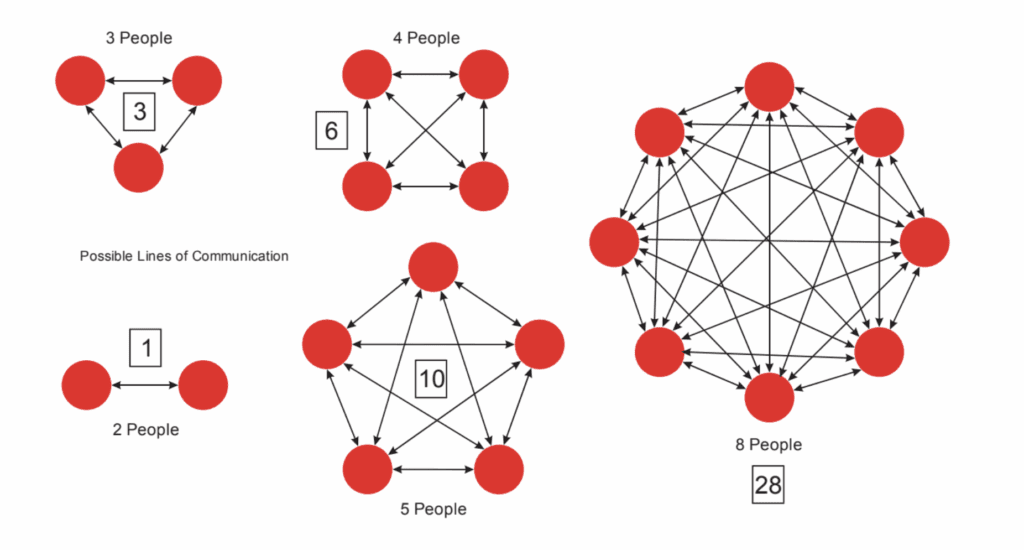
Complexity kills projects. If you look at the forensic studies done on failed projects, you will see a trail of doom spawned by the complexity the project team had to overcome. Complexity grows exponentially. Like lines of communication. Two people have one clear line of communication. Four people have six lines, and 20 people have 190 lines of communication. Modern construction projects aren’t just challenging; they’re inherently complex. A team-of-teams comprised of diverse companies come together and must use and install sophisticated technologies within stringent regulatory environments. Unmanaged complexity frequently manifests into confusion, cost overruns, and missed deadlines. It can lead to cascading events that completely undermine a project.
Strategy #3: One Team Approach
Collaborative Partnering allows the team to form as ONE TEAM focused, and committed, to the project’s success. This ability to coalesce all interests toward what is best for the project, works to melt away project complexity, allowing the team to operate effectively even in a highly complex environment.
Progressive Design Build (PDB), and other collaborative delivery methods, allow the team to form as ONE TEAM more deeply as the barriers typically included in contracts are better aligned, and the team forms much earlier in the construction process. Unlike traditional delivery methods, collaborative delivery integrates design and construction processes early, leveraging iterative feedback loops and stakeholder involvement. This approach allows for real-time adjustments and fosters collective problem-solving.
Force #4: Spearin Doctrine & Standard of Care
The Spearin Doctrine is based on a U.S. Supreme Court ruling in 1918 that remains a key construction law today. The Spearin Doctrine says that the builder/contractor/subcontractor can assume that their contract (including plans and specs) is error free with no omissions.
The Standard of Care common law for the performance of design professional services requires that the design professional uses the ordinary and reasonable care usually exercised by one in the profession. The designer is accountable to a reasonable standard of care; therefore, errors and omissions are acceptable within a limit. They do not have to provide perfect plans or specifications.
This sets up the project owner with a gap. There is a gap where the owner must provide the contractor a perfect set of plans and specifications; and the designer is not required to supply a perfect set of plans and specifications. Who “owns” this gap is like a hot potato on many projects.
Strategy #4: Measurement & Account-Ability
Creating a high trust project team that can develop a target budget and then has the flexibility to balance between cost, scope, and schedule provides a project team the ability to adjust along the way to meet the budget and close the gap. This Spearin Doctrine and Standard of Care gap can be managed by the project team. Using Collaborative Partnering along with clear measurement, defined expectations, and accountability are essential for navigating the gap. Transparent metrics and regular evaluation checkpoints encourages stakeholders to agree upon performance metrics upfront, promoting responsibility and transparency. Using OrgMetrics’ Construction Scorecard can help project teams measure how well the team is achieving their goals.
Putting Strategies into Action: Unlocking Your Collaborative Advantage
Mastering the Four Forces with these strategic approaches positions your projects not merely to survive but to thrive. Collaborative Partnering, a Trusted Leadership Mindset, One Team Approach, and rigorous Measurement & Account-Ability transform the way stakeholders interact, solve problems, and achieve collective success.
The path to superior construction outcomes is not through solitary effort or adversarial relationships, but through genuine, structured collaboration. Your projects deserve nothing less.
~ Sue

Sue Dyer, MBA, MIPI is a Master Partnering Facilitator & Founder for OrgMetrics LLC, WSJ bestselling author on Trusted Leadership for construction leaders, Founder of the International Partnering Institute, and President of sudyco® LLC. You can contact Sue at suedyer@orgmet.com or 510 504-5877.