



The Stakeholder You Leave Out May Be the One Who Stops the Project
In my work, I have seen Construction teams define stakeholders numerous ways. Some definitions include the Core team from the owner, contractor and designer who are delivering the project. As Partnering Facilitators, we typically define stakeholders as anyone who can materially affect the project—or be materially affected by it. Internal stakeholders may include the owner’s leadership, project team, contractor, designers, operations staff and, depending on the project and phase, the end users and operators. External stakeholders may include regulators, utilities, elected officials, Indigenous nations, neighboring property owners, businesses, municipalities and community organizations.
For many years, I’ve asked teams a simple question:
Who are the potential dealmakers and dealbreakers?
If we include them, can they help the project succeed? If we exclude them, can they delay, damage or stop it?
Why Include Stakeholders?
Including stakeholders can take longer, but it means they will help you co-create solutions. Excluding stakeholders does not eliminate their concerns. It merely delays those concerns until they are more expensive and difficult to address.
Case Study #1
The Data Center That Arrived as a Secret
Project Blue, a proposed multibillion-dollar data center near Tucson, Arizona, was discussed for roughly two years under nondisclosure agreements (NDAs). Important details about the project and its water and energy demands were not available to the public. Some elected officials also said they lacked important information. When the project became public, many residents felt that decisions had already been made without them. Water use became a major concern in a desert community with a strong conservation culture. Opposition grew quickly. Public meetings became heated, trust deteriorated and the Tucson City Council eventually voted unanimously to discontinue annexation and development discussions.
The community’s concerns were predictable: water, energy, noise, traffic and transparency. The secrecy allowed people to conclude that decisions were being made about their community without their participation. Interests in engaging stakeholders and the appropriate level of transparency need to be balanced with the privacy maintained through NDAs.
How Do We Define the Stakeholders?
Begin with your internal members:
- Who approves, funds, designs, builds, operates and maintains the project?
- Who controls decisions, information, resources or access?
- Whose knowledge is needed?
- Who will be held responsible for the result?
Then look outside the project:
- Who lives, works, travels or owns property nearby?
- Whose water, utilities, traffic, environment or business may be needed or affected?
- Who has approval, enforcement or political authority?
- Who can organize opposition, appeal a decision or influence public opinion?
Finally, apply the dealmaker–dealbreaker test:
If we engage this group/individual well, how could they help us? If we ignore them, how could they hurt us?
Do not limit the list to supporters. The skeptical stakeholder may identify the risk everyone else has missed.
Case Study #2
Dakota Access: Consultation Is Not Engagement
The Standing Rock Sioux Tribe raised concerns about drinking water, cultural resources, treaty interests and the consequences of a possible spill. Formal consultation occurred, but it did not create confidence that the Tribe’s concerns were influencing the decisions. By 2016, thousands of people had joined protests near Standing Rock. Construction was delayed, the project attracted international attention and years of litigation followed. Energy Transfer later maintained that the protests caused months of delay and hundreds of millions of dollars in additional costs. The pipeline was ultimately completed, but at an enormous financial, political and reputational cost.
I facilitated tribal stakeholder engagement for a similar project where the owner learned that effective engagement is more than checking a box. Engagement is hard work, but it creates an opportunity to address concerns before positions harden and construction begins. One way to think about all stakeholder engagement is up-front investment to mitigate larger costs over the life of the project.
How Much Should We Include Them?
Not every stakeholder belongs in every meeting. The level of engagement should reflect both their influence and how significantly they are affected. Here’s a rough rule-of-thumb.
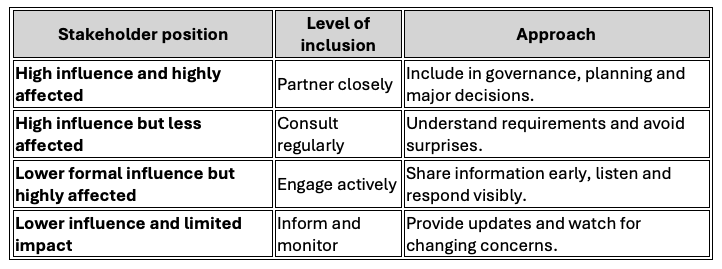
Stakeholder positions can change quickly. A neighborhood group may galvanize and become a major political force. A utility may suddenly become critical path. An operations representative may identify a design that cannot be maintained. Draw a picture at the project’s outset – later review the stakeholder map at every major project transition.
When the Contractor Is Treated as an Outside Stakeholder
Stakeholder exclusion also happens within the project team. I have seen versions of this on many projects. The owner makes decisions about sequencing, design priorities, access or schedule commitments and informs the contractor afterward. The owner may believe it is maintaining control. The contractor experiences it as being held responsible for decisions it did not help make. The owner may lose key insights only the contractor can bring. The result is often defensiveness, conservative estimates, costly changes, excessive documentation and claims positioning.
Contractors do not need to control owner decisions. But when a decision affects cost, constructability, safety, sequencing or schedule, their knowledge should be in the room.
The Costs and Benefits
Good stakeholder engagement requires time, communication, facilitation and follow-through. It may reveal disagreement or require changes. But those are visible and manageable costs.
In contrast, poor engagement can result in:
- Redesign and change orders
- Delays and work stoppages
- Permit appeals and litigation
- Political intervention
- Claims and damaged project relationships
- Reputational harm
- Loss of community trust
Good engagement also produces valuable information. The contractor identifies what cannot be built, operations staff identify what cannot be maintained, neighbors identify traffic or noise problems, regulators identify approval risks and tribal representatives identify cultural and environmental concerns that may not appear in technical studies.
Most importantly, engagement creates procedural fairness. People are more likely to accept a decision—even one they do not fully support—when they believe they were heard and the process was honest.
Leave No Important Chair Empty
Before your next major decision, look around the table.
Who is missing?
The stakeholder who asks difficult questions early may feel inconvenient. The one who asks them after construction begins may become a dealbreaker.
Make sure every important perspective reaches the project at the right time—before the cost of listening becomes the cost of not listening.
~ Kate

Kate Stewart’s distinguished career spans 25 years as a professional neutral and organizational development consultant for numerous large organizations. Her expertise includes Partnering facilitation on high-profile projects, such as the Kansas City International Airport mega program. She has served as a coach, trainer, researcher, and thought leader across various industries and disciplines on both domestic and international fronts. Kate is based in the picturesque Paradise Valley, Montana, where she enjoys hiking, gardening, and reading.
For more information, please contact Kate Stewart, katestewart@orgmet.com / (406) 414-9922 (cell) or OrgMetrics RobReaugh@Orgmet.com / (925)449-8300