



Do the Impossible— 5 Negotiation Techniques to Break Through Impossible Deadlocks
“If we try to play like the Yankees in here, we will lose to the Yankees out there.” — Billy Beane
What a great concept to bring to the table when you feel stuck in negotiation. Most negotiations stall not because a solution doesn’t exist, but because everyone in the room has already agreed that it doesn’t, often without saying so. The moment we accept “this is just how it is” we stop looking. Doing the impossible starts somewhere much simpler: staying open to possibilities that have not been named yet.
When “Impossible” Wasn’t: The Oakland A’s
I recently watched the film Moneyball, based on the Michael Lewis book about the Oakland Athletics in the early 2000s. The A’s had the third lowest payroll in Major League Baseball ($41M), a fraction of what teams like the New York Yankees ($126M) were spending. Every scout, every rival GM, every sportswriter agreed on the same thing: a team with that payroll could not compete for a championship. And this had become the conventional wisdom. Organizations needed the big bucks to bid for top prospects and star players the scouts agreed to be talented.
Billy Beane refused to accept the premise. Instead of competing on the field everyone else was playing, he asked a different question: what actually wins games? Working with statistical analysis, his team started valuing players using concepts like on-base percentage as a means to get more runners, who then translated into runs. Beane and his staff started building the team based on the data, rather than the traditional, more visible measurements scouts traditionally prized (physical size and strength, foot speed, throwing velocity, or arbitrary non-measurables like “a pretty swing.”) By doing so, they turned to undervalued talent nobody else wanted to pay for.
The A’s went on to win 20 consecutive games in 2002, an American League record, and made the playoffs on a payroll a third the size of the league’s biggest spenders.
In negotiation, we call the ability to explore and find new value “expanding the pie.” Beane fundamentally changed baseball by expanding the pie and offering a new way to evaluate talent, which has been much more broadly implemented across the major leagues.

Expect a Miracle
What if we thought of a miracle simply as a change in perception? You don’t need new facts to find a breakthrough. Like Billy Beane, you need a new lens. The counterpart across the table hasn’t changed. The constraints haven’t changed. But the moment you see the situation differently, options appear that were invisible a minute before.
Great negotiators are able to explore and reframe a problem until a solution emerges that gives everyone what they actually need. The act of expanding the pie in negotiation has the secondary benefit of leaving both sides with a greater respect and understanding than they started with.
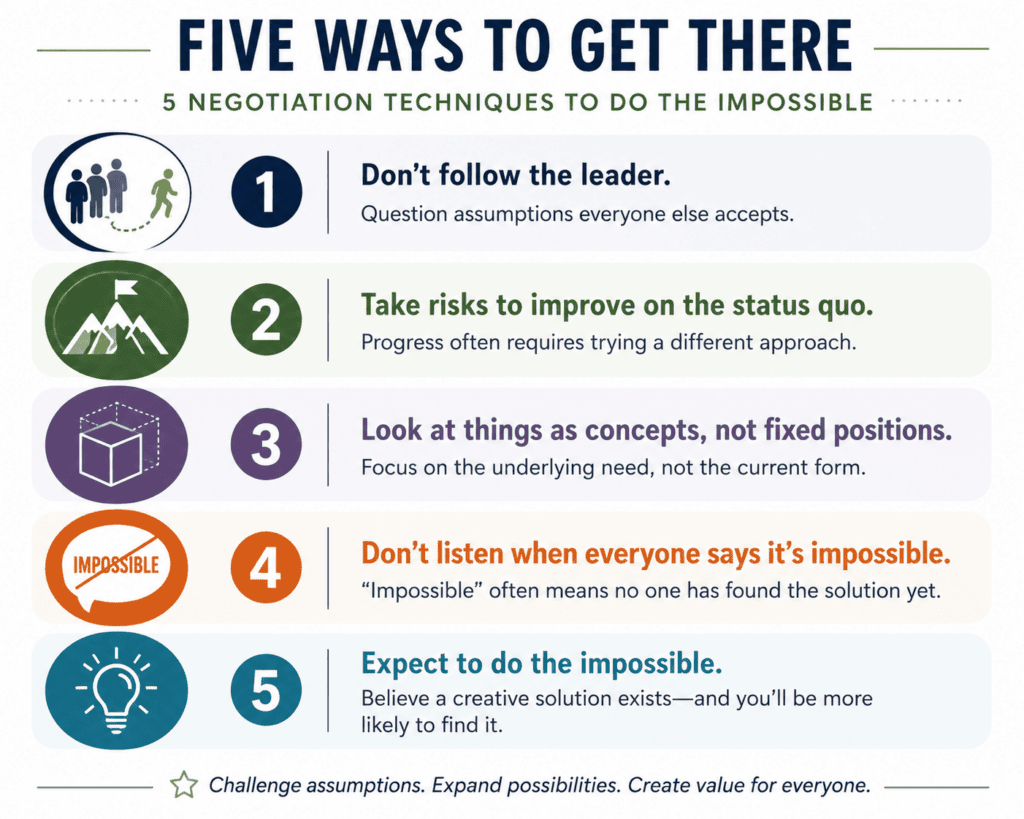
Five Ways to Get There
1. Don’t follow the leader. If everyone assumes the deal has to look a certain way, that assumption is worth questioning out loud. The first person to name a different shape for the agreement often becomes the one who sets a new path. When you are preparing for a negotiation, include someone who thinks differently than you do!
2. Take risks to improve on the status quo. It feels safer to keep things as they are, even when “as they are” isn’t working for anyone. Real progress usually asks you to risk the comfort of the familiar. If you are using “tried and true” methods but have not come to an agreement, it’s time to go out on a limb. Take a risk. The worst case scenario is you are in exactly the same space.
3. Look at things as concepts, not fixed positions. A number, a deadline, a clause… none of these are the actual goal. They are expressions of an underlying need. Once you separate the concept from its current form, you can rebuild it in a way nobody had considered. In construction we tend to identify our side’s “position” and then reinforce the argument. Be open to testing a new route.
4. Don’t listen when everyone says it’s impossible. “Impossible” is usually shorthand for “no one has found it yet.” That’s a very different claim and worth remembering the next time the room decides something can’t be done. Great negotiators remain positive and confident that a new agreement can be reached because the solution simply hasn’t presented itself yet.
5. Expect to do the impossible. We tend to live up to our own expectations. If you walk in believing a creative solution exists, you’ll notice things you’d otherwise miss. Often, others sense that conviction too and start helping you look for it. Be the champion for positivity and hope. When given permission to be creative, team members will typically rise to the challenge.
This Week’s Practice
Before your next negotiation, ask yourself: What am I assuming is fixed that might actually just be familiar? Sit with that question before you sit at the table. Do the impossible often enough, and it stops being a surprise, it becomes your expectation and soon… your reputation.
~ Louisa
Speaking of Moneyball, for those of you who don’t know me well, I grew up in the baseball world. By complete coincidence, my backyard hosts the Little League Intermediate 50/70 Baseball World Series, happening right now on ESPN 2 (August 2nd – 9th)! Something we now are so proud to be neighboring. If you are a fan, break away from your project and make the drive to see some amazing 12 year olds play high level of baseball. See the schedule here – and if you see me (I’ll be there daily), say Hi!

Louisa brings a fresh and energetic approach to DISC training, combining her passion for people with the collaborative methods of OrgMetrics. As a Certified DISC Trainer, she helps construction project teams understand communication styles, strengthen relationships, and work together more effectively. Louisa’s approachable style makes DISC accessible, engaging, and directly relevant to the real-world challenges teams face. She is based in the Livermore, CA, where she enjoys coaching youth sports, volunteering at her children’s schools, and spending time with family.
For more information, please contact Louisa Garrett, louisagarrett@orgmet.com / (702) 466-8722 (cell) or OrgMetrics robreaugh@orgmet.com / (925) 449-8300.