


The Partnering Roadmap: Moving Your Project Team from Controlled to Creative
Collaborative Partnering has become essential for construction project success, yet many teams struggle to move beyond basic conflict resolution. Further, sometimes teams believe they are “beyond Partnering” simply because they are “not fighting.” This is a pretty low standard for success. Understanding where your project team sits on the partnering spectrum and how to advance to higher stages can transform not just project outcomes, but profitability for everyone involved in the project.
What Is Collaborative Partnering?
Collaborative Partnering is a structured approach where contractors, owners, subcontractors, designers, and construction managers commit to working together as allies rather than adversaries. It involves establishing shared goals, open communication protocols, and joint problem-solving processes that benefit the entire project rather than individual parties.
The Four-Stage Journey
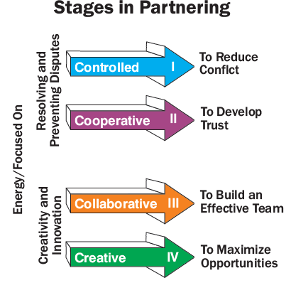
Not every partnering session is the same. It should not be the same, because your objective for the session varies by how the team is operating. Every project team exists somewhere along one of four-stages. Each stage has distinct objective, based on what is going on within the team and what needs to occur to achieve the objective. Let’s look at the four stages.
Stage I: Controlled
When chaos has erupted or conflict looms, and some teams bring old baggage from past projects. Stage I partnering focuses on getting control. The primary goal is reducing conflict by getting agreements on how we are going to work together. Small agreements lead to alignment and defuse the need to protect your interests. Team members agree on basic working protocols to prevent conflict from escalating. A team at Stage 1 needs to focus on negotiating ways of working together and resolving past issues.
Stage II: Cooperative
Here, team members begin knowing each other as people and are less adversarial. Focusing on trust-building allows the team to increase their level of cooperation. Focusing on measurable goals and consistent follow-through helps. Exhibiting trustworthiness by achieving promised deliverables creates the foundation for genuine cooperation.
Stage III: Collaborative
The breakthrough stage occurs when the project team develops a successful working history together. The lines between different parties blur as everyone joins the same side of the table to examine project challenges collectively. The project itself becomes the focus rather than protecting individual interests. Trust runs high and communication flows freely across all team members.
Stage IV: Creative
This pinnacle stage transforms teams into innovation engines. Creativity drives decision-making, with goals focused on achieving what others might consider impossible. Teams move fluidly to meet new challenges, making obstacles work for the project rather than against it. Here, true quality improvement and breakthrough solutions emerge.
The Reality of Progression
Understanding these stages reveals a crucial truth: real quality improvement happens in Stages III and IV, where creativity and innovation drive the team. Stages I and II, while sometimes necessary, focus primarily on preventing or resolving conflicts – sometimes unavoidable, but not the end goal.
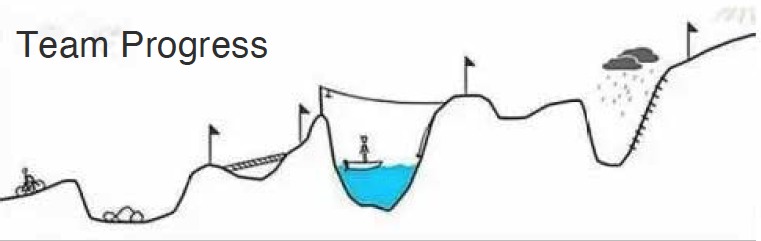
Teams don’t always progress linearly. Projects can regress to earlier stages when new challenges arise, team members change, or external pressures mount. The key is recognizing these shifts and making sure that your partnering focus is appropriate for the stage the team is experiencing.
Moving Forward
Progression through partnering stages isn’t automatic. It requires intentional effort and regular reinforcement. Teams must honestly assess their current stage and identify specific actions to advance. This might involve establishing measurable trust-building goals in Stage II, or implementing joint problem-solving protocols to reach Stage III.
The investment pays dividends. Moving through partnering stages isn’t just fulfilling—it’s highly profitable for all parties involved. Projects that reach Stages III and IV consistently deliver superior outcomes: better quality, reduced conflicts, improved schedules, and enhanced innovation.
Your Next Step
Advancing through the partnering stages takes intention and a shared understanding of how the team is functioning. High-performing project teams are the ones that regularly reflect on how they’re working together, not just the tasks at hand.
As you look at your current project, consider which of the four stages best describes your team right now. What does this stage need in order to move forward? And what is one small shift that could help deepen collaboration or spark new solutions?
Even subtle improvements in how a team partners can create measurable gains in performance, predictability, and project success.
~ Sue

Sue Dyer, MBA, MIPI is a Master Partnering Facilitator & Founder for OrgMetrics LLC, WSJ bestselling author on Trusted Leadership for construction leaders, Founder of the International Partnering Institute, and President of sudyco® LLC. You can contact Sue at suedyer@orgmet.com or 510 504-5877.