


I spoke with a project leader this week who wanted support in figuring out how to help his project team succeed. After our conversation I began to realize that the team is mired down in the bureaucratic culture of the owner’s organization.
This of course is not uncommon. Most projects take on the culture of the owner’s organization. But is this best for your project? Is it best for the owner’s results? For most owners and projects, it is not. Bureaucracy adds layers to decision making. It often operates with committees and decision making by broad consensus. People attend many meetings where often they talk about the same issues and no decisions are made or direction given. Review processes operate within this practice and make it next to impossible to get a design completed, or a project finished on time. And one of the MOST impactful parts of having your project within a bureaucracy is that no one takes ownership of the project results. But there is always a lot of blame when the project fails.
Why does the project team adopt the owner’s bureaucratic culture and ways? FEAR.
Large entities, and especially public entities, live in a political world. That world plays a zero-sum game. In this zero-sum game/political world, there is little to no compromise or collaboration available. In a zero-sum game I do nothing for you unless and until you do something for me. There is a net sum of zero between us. I don’t owe you. You don’t owe me. But I suspect you. I look at every interaction with caution because I believe you are trying to take advantage of me in some way. And of course, there is a strong tendency toward “if I don’t make the decision, then I can’t be wrong” decision making. This fear-based culture of the owner’s organization gets transferred to your project by default.
How can you bust this bureaucracy operating system? Here are three techniques you can use today to create your own project operating system; what I like to call a Trustaucracy!
Step #1 Assess How Bureaucracy Is Impacting Your Project
There is the old saying that a fish does not see the water it’s swimming in. The same can be true for those working in a bureaucracy – it is just normal. So, the first step is to take the IPI Bureaucracy Evaluator. This simple assessment helps you and your team see which of the ten dysfunctions of a fear-based bureaucracy are playing out on your project and to what extent. Then sit down with your project team (owner, builder, contactor, designer, etc.) and have a conversation on how the bureaucratic dysfunctions are playing out on your project. Identify the most impactful areas and start there with improving the impacts.
Step #2: Create A Shadow Organization
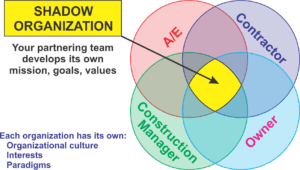
Many large organizations have learned that to innovate new things, they need to create a new team that operates outside of the large organization’s norms. This “shadow organization” operates under a new set of norms, practices, and processes, that is conducive to the success of the endeavor. They are tied to the larger organization but work in the shadows, not being hamstrung by the bureaucratic requirements and tendencies. Organizations that recognize this need can support the project team in building a shadow organization.
The bureaucratic organization that does not see the need for a project team to operate differently in order to succeed makes it more challenging. But it is not impossible for the project team to develop their own unique shadow organization with new project operating norms. In your shadow organization, astute team members from the bureaucratic organization serve as a liaison between the larger organization and the project team. They facilitate communication and decision making to meet the needs of the project. They also serve as a “ceiling” that protects the project team from the political and external pressures from the large organization that would prevent them from succeeding.
Step #3: Commit to a High Trust Project Operating System
If you’re not sure what a successful project operating system looks like, Partnering 3.0 offers a structure and team training on how a project team can create a high trust operating system for your project. It entails using the Collaborative Partnering Framework plus the IPI Project Leader Certification training. You can learn more by grabbing a copy of the IPI Partnering 3.0 white paper.

When your shadow organization can drive out fear and build trust, you will be able to grow into a high-trust high-performing project team and deliver an exceptional project. This is of course, is in the best interest of the bureaucratic organization.
Bureaucratic organizations need their projects to succeed, and it can be a true challenge to figure out how to be successful when the bureaucracy is impacting how the project team operates. If you use these three techniques, you can start busting the bureaucracy that is negatively impacting your project and hopefully move toward operating as a high-trust high-performing project team. You and your team can become a Trustaucracy!
Sue

Sue Dyer, MBA, MIPI is a Master Partnering Facilitator & Founder for OrgMetrics LLC, WSJ bestselling author on Trusted Leadership for construction leaders, Founder of the International Partnering Institute, and President of sudyco® LLC. You can contact Sue at suedyer@orgmet.com or 510 504-5877.