


Internal Strategic Partnering — Leveling Up Your Organization
If you have been following our newsletter, in May I led a Partnering Fundamentals Training on behalf of the San Francisco Collaborative Partnering Steering Committee, where we had a wonderful class comprised of all six of San Francisco’s departments who deliver projects and multiple contractors, architects, engineers, and other construction professionals. During the training we received three questions that have all come up so frequently that I thought it was worth sharing the answers with everyone. Note, the answers to all of these questions can be found in the San Francisco Partnering Field Guide available at www.sfpartnering.com.
- Our Partnering Spec is geared toward low bid construction (design/bid/build). How do we tailor it to Collaborative Delivery Models (e.g., CM/GC, Design Build, or Progressive Design Build)? – See May 11, 2026 Newsletter
- How do I select a Partnering Facilitator for my team? – See June 15, 2026 Newsletter
- Is it possible to set up a Partnering Process between stakeholders within my organization to improve collaboration?
This is the third of the three – please send me more “mailbag” questions that you may have!
Is it possible to set up Partnering between Departments or individual Stakeholders within my Organization?
In a word, yes! You can absolutely set up internal strategic partnering within your organization to help improve alignment or project delivery. If I have learned one thing in my career it’s that the concepts of aligning goals, setting up a “mission-first” mindset, developing an issue escalation path and procedure, and making commitments to each other to achieve the goals leads to better outcomes whether it’s for a construction project, an internal initiative, or between two departments that are experiencing conflict.
I’ll share a few examples of ways we have helped internal teams:
- Design Phase for Owner’s Team
- Tenant Improvements/Concessions
- Resolving Conflict Between Groups
1. Design Phase Integration for Owner’s Team
To start, it is important to remember that our projects can often take 5,10, or even 20 or more years to plan, permit, program, and then design prior to the start of construction. During the planning, programming, and early design phases, the team is working through potential scopes at a high level and will need to make compromises to align the intended budget with the intended scope. These early discussions can greatly impact the ultimate design direction the owner’s team takes and difficult conversations can often lead to “camps” emerging or conflict arising when cuts or compromises need to be made.
Partnering during early phases often involves gathering a variety of stakeholders together to help them better understand the objectives of the phase and to tap into the collective wisdom of the group to optimize the future construction. During this time, organizations may be bashful about identifying a clear decision-maker. Partnering will enable organizations to clarify who that individual (or often who the empowered body) will be, to ensure that the team doesn’t get stuck at impasse. Similar to a typical project, a simple issue resolution path and a set of policies will help any initiative or early set of programming studies enable teams to remain focused and avoid prolonged, circular arguments about an approach to the program.
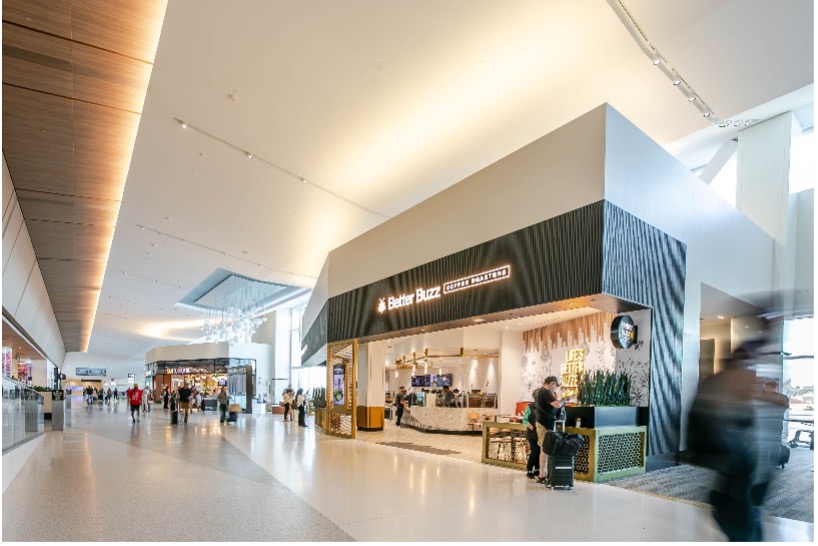
Better Buzz Coffee Shop, San Diego Airport, Terminal 1
2. Tenant Improvements or Concessions
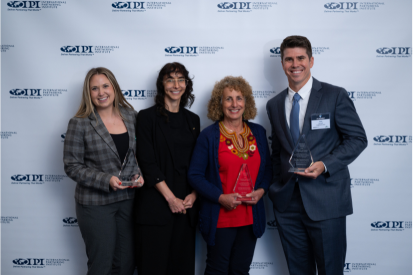
For complex tenant improvements or airport terminal openings, Partnering helps align the Design and Construction division responsible for the base building with the Real Estate or Business teams responsible for tenant agreements. It also brings concessionaires into the process so their interior spaces can be designed and constructed in time for opening day. For new terminals, the stakes are incredibly high. For example, at San Diego International Airport, the IPI Award-winning team, nicknamed “The Foodies,” focused on internal collaboration to develop a new set of standards and successfully implement them through early integration.
They were also able to support design completion and construction delivery of the 16 new concessions spaces in New Terminal 1 by aligning the executive teams of each division, setting up structured meetings for each concessionaire, and focusing on the successful onboarding and integration between the base building team and the architects and contractors who performed the final buildouts of each space.
Concessions construction involves relatively simple projects made complex because they are a) delivered in a heavily regulated airport environment and b) each of the individual spaces are a one-off with different needs and conditions. In terms of ROI, the on time delivery of the spaces has contributed to a 42% increase in revenue for SAN since the New Terminal 1 opened in September 2026.
3. Resolving Conflict Between Groups
A third common use case for internal strategic partnering is when two internal groups who support design and construction delivery or other internal initiatives are struggling to work together in a collaborative way. At the outset, the SAN Foodies group needed to gather lessons learned from recent individual tenant upgrades that struggled to deliver on time. Delayed delivery was causing frustration and resulting in blame.
Investing time to understand the root cause revealed that clarifying roles and responsibilities, establishing clear owners for the project delivery, and requiring that the two organizations physically meet in person (frequently in the field), helped dramatically improve alignment, establish deeper relationships, and build trust. Improved results followed quickly once the teams were structurally aligned and the leaders of the two divisions met regularly to demonstrate commitment to a long-term relationship approach.
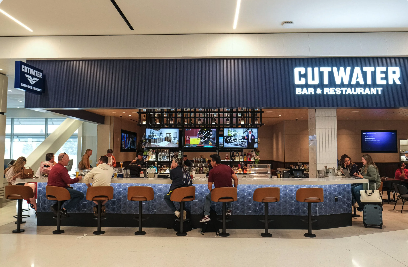
Cutwater Bar & Restaurant, San Diego Airport, Terminal 1
For other organizations, we have used partnering to bring technology professionals and design-build teams together when they were struggling to balance the project budget with evolving technology requirements.. Or when individuals become frustrated because the budget established at the outset of a project no longer supports technology that has evolved over time. For these team members, it can be valuable to remind them that a) they are on the same team and have overlapping needs, b) they have a place to go when they disagree, and c) they are interdependent–they each provide expertise, energy, and resources to support the ultimate delivery of the project.
The old saying in negotiation is that it is harder to navigate issues on the same side of the table than it is across the table. To make it more personal, arguments kept “inside the family” are often harder to reconcile than issues where you have a contract in place.
Internal Strategic Partnering is a powerful tool to help organizations deliver complex programs. It can help owners get aligned during the planning or design phase, like in the initial stages of a mega program, when they need to implement a complex initiative, like a dozen or more concessions spaces that all need to be delivered by the same date, or for an internal team that gets wrapped up in what they believe is a personality conflict but is really more of a structural problem or a task conflict.
Each of these examples demonstrates how Internal Strategic Partnering can improve alignment and strengthen project delivery. We’ve found that investing in collaboration early delivers substantial returns throughout the life of a project. Let me know if you’re facing a challenge where Internal Strategic Partnering could help, and thanks for reading!
– Rob
 Rob Reaugh is President of OrgMetrics LLC. He facilitates the City and County of San Francisco Collaborative Partnering Steering Committee and currently works with San Francisco International Airport, San Jose International Airport, BART, Caltrans, and others. He holds a Masters’ Degree in Alternative Dispute Resolution.
For more information please contact Rob Reaugh, RobReaugh@Orgmet.com / (925) 487-2404 (cell), or OrgMetrics, (925) 449-8300.