

Partnering Mailbag – Setting up Collaborative Partnering for Different Collaborative Delivery Models
Last week I was leading a Partnering Fundamentals Training on behalf of the San Francisco Collaborative Partnering Steering Committee. We had an amazing class that represented all six of San Francisco’s Chapter departments and multiple contractors, architects, engineers, and other construction professionals. During the training we received three questions that have all been asked multiple times. I thought each question was noteworthy enough to share with our readers. (Note, registration for the Partnering Fundamentals training and the answers to all of these questions can be found in the San Francisco Partnering Field Guide available at www.sfpartnering.com.)/p>
- Our Partnering Spec is geared toward low bid construction (design/bid/build). How do we tailor it to Collaborative Delivery Models (e.g., CM/GC, Design Build, or Progressive Design Build)?
- How do I select a Partnering Facilitator for my team?
- Is it possible to set up a Partnering Process between stakeholders within my organization to improve collaboration?
I’m going to answer these three questions in a series of newsletters. If you have any other “mailbag” type questions that you may have, please feel free to send them to me! First, Partnering for collaborative delivery methods.
Partnering for Different Collaborative Delivery Models
Shoutout to the organizations that set up a Partnering Specification – you are 90% of the way there! I believe the team will derive significant value from implementing Partnering as early as possible after the initial Notice to Proceed. I’ll share a few thoughts for each delivery model:
Design-Bid-Build
For low bid projects and to set expectation, I typically recommend that team’s kick off Partnering within 30-60 days of project Notice to Proceed (NTP). My personal preference is to hold the kick-off Partnering session after the contractor submits the Baseline Schedule and Schedule of Values (SOV). In my experience, Partnering sessions held prior to these critical documents often lack the depth of conversation about reviewing and resolving submittals or the contractor’s plan of attack. Or there may be an underlying issue the team needs to resolve to help reconcile how the Baseline Schedule needs to be developed.
Once you kick-off the Partnering effort, based on the complexity of the project, you can set up your monthly, bi-monthly (my personal preference), or quarterly Partnering sessions based on the scope, the tempo of the project, and the risk level.
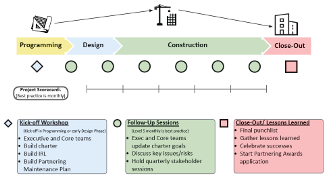
Structured Collaborative Partnering for Design/Build (pg. 41, SF Partnering Field Guide)
CM/GC or Design-Build
Mp>In CM/GC, it’s important to recognize that the architect and engineering firm(s) have already been working with the client organization for months (or years) before the general contractor (GC) shows up. So, one of the key objectives is to align roles and expectations between the owner, the designer, the Construction Management group, and the CM/GC contractor. You also need to help bridge that “trust gap” where the contractor’s team is newest to the party and may need introductions to key stakeholders or need direct interface with the client’s lead people to foster trust. During the design/constructability review phase, I prefer to hold our kick-off within 30-60 days of NTP (similar to low bid). After that, I like to set up the Partnering sessions roughly one month prior to the 30%, 60%, and 90% design submissions. These design deliverables with stakeholder reviews are typically set up quarterly, so meeting one month prior to submission of each deliverable allows you to align expectations both internally as a team and externally with your key stakeholders regarding the purpose and goals for the deliverable.
Note – it is common for stakeholders to lack a complete understanding that during each phase they are supposed to give different feedback (e.g., civil and massing at 30%, floor plan flow and exterior layouts at 60%, and finishes, fixtures, or other aesthetic details during the 90% design review). It is also common for stakeholders who don’t work in construction every day to visualize two dimensional plans, so any opportunities you can take do to 3D model “fly throughs” or to visit other sites where they can see it, will only enhance your design reviews.
Once you hit construction, my personal default setting preference for CM/GC is to meet every two months. The team can always ramp up and meet more frequently when enhanced collaboration is needed or can scale back if they are in “cruise control” or have schedule lags during procurement.
Design-Build and Progressive Design-Build
For Design/Build (D/B) projects, I recommend a similar approach to CM/GC, but you have an enhanced need to align the design team and the design manager with the client leadership and stakeholders. A practice we have used on many of our D/B and P/D/B projects is to set up our Core and Executive Partnering, and in addition hold a DISC “Building with Style” Training (contact us to set up your training).
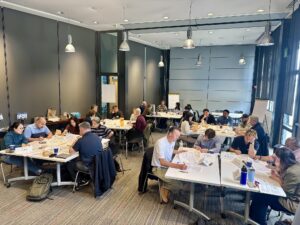
We used this for two 2026 IPI Gold Level-Winning projects this year, SFO Courtyard 3 Connector (C3C) and the UCSF Health Sciences Instruction and Research (HSIR). In both cases, setting up a training where the entire team develops empathy and a common language to de-escalate conflict and more effectively navigate project challenges, paid huge dividends. From experience, early joint training helps teams gel and navigate important decisions during the “storming” and “norming” phases of a project. If you kick-off the project by conducting the training first, the Kick-Off Partnering session switches from a getting to know you-type meeting, to a substantive project visioning and strategy workshop, focused on co-creating the project mission and systems for collaboration.
Setting up the Allowance to Pay for Partnering
An important item to acknowledge for Project Mangers is that starting the Partnering earlier on will add administrative cost to the project. For organizations that are accustomed to holding Partnering only during the construction phase, the team will need to add $30K – $60K to accommodate the additional Partnering sessions. That being said, the time invested in Partnering up front combined with the schedule benefits of collaborative delivery projects can result in significant savings for the construction program. High performing teams leverage the process and find value for the client and the project. Trust that the early investment in time will result in better throughput and productivity.
Let me know your preferred structure for Partnering on collaborative delivery methods and stay tuned for future articles where we cover how to select the best Partnering Facilitator for your project team and how to set up a Partnering processes within an organization (what we call Strategic Partnering).
– Rob
Rob Reaugh is President of OrgMetrics LLC. He facilitates the City and County of San Francisco Collaborative Partnering Steering Committee and currently works with San Francisco International Airport, San Jose International Airport, BART, Caltrans, and others. He holds a Masters’ Degree in Alternative Dispute Resolution.
For more information please contact Rob Reaugh, RobReaugh@Orgmet.com / (925) 487-2404 (cell), or OrgMetrics, (925) 449-8300.
 Rob Reaugh is President of OrgMetrics LLC. He facilitates the City and County of San Francisco Collaborative Partnering Steering Committee and currently works with San Francisco International Airport, San Jose International Airport, BART, Caltrans, and others. He holds a Masters’ Degree in Alternative Dispute Resolution.