

When Your Push Starts to Shove… How Moments of High Stress Reveal Our Personality
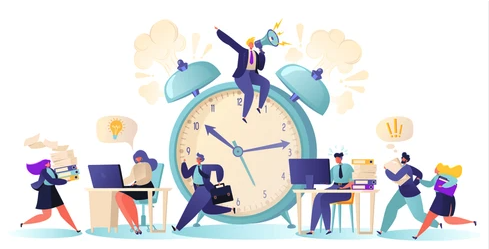
We often start the new year rested, excited for what’s ahead, full of resolutions and a sense of calm. Then a few weeks pass and in the blink of an eye, the Super Bowl is over, Valentine’s Day is around the corner, and both work and personal calendars are completely filled. Those resolutions you set begin to feel more like high expectations, and that sense of calm is quickly replaced with a heavy set of weight on your shoulders.
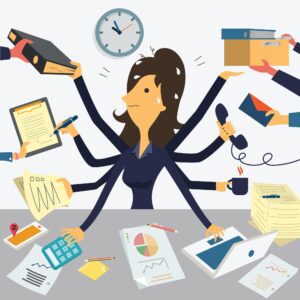
This year started with a ton of positivity. I was promoted at OrgMetrics, we hired a new Executive Assistant and brought on a part-time Admin Assistant. We have the help we need! Unfortunately, this meant I needed to start preparing for my new role while training my replacements. And to add more to my plate, I helped run this year’s San Francisco Collaborative Partnering Awards Ceremony and start a new training program all while managing my regular workload. The gaps of time outside of work are also filled as I tend to be a “yes” person. Volunteering, youth sports, coaching, board meetings, a DIY bathroom renovation, kid projects, and school have filled every remaining minute.
Our calendars don’t just fill up, they become layered. More than once at work, I’ve caught myself thinking, “This would be so much easier if I could just pause everything else while I train.” I always have intention to give 100%, but lately it feels like I’m being pulled in too many directions and am missing some of the finer details.
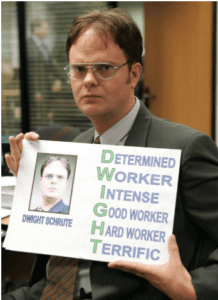
After one meeting where I was talking faster than usual, pushing for quick decisions, and losing patience when team members were bogging us down, someone jokingly said to me, “Excuse me, but I think your (High) D is showing.” And honestly, they weren’t wrong. Typically, I’m patient and open to talk things through, but we needed to get through the agenda, and I was pushing through tasks quickly to get them off my plate. In that moment, I flexed my direct and assertive D…possibly too much.
Stress Accumulates and Amplifies our Behaviors
I came into the year walking a little taller, excited for what was ahead. What I forgot was how much time and energy it takes to get to the next step. Stress, both positive and negative, tends to build up and it can be easy to not recognize when it accumulates. When teams build, scale, train, deliver, and adapt all at the same time, we tend to overly rely on certain individuals. The entire team suffers when those individuals are not given (or do not give themselves) a margin for error.
When stress accumulates during busy seasons, our tendencies don’t change… the stress tends to amplify our behaviors. Under pressure, we don’t suddenly become different versions of ourselves; we become more of who we already are… for better and for worse. That’s where DISC becomes incredibly useful. It helps us understand not only ourselves in these moments, but how others are experiencing the same workload very differently.
When capacity is maxed out, the same environment can feel very different depending on someone’s natural style. A high D (Dominant Style) may feel boxed in by delays or slow decision-making. They may lash out at people under stress who are sweating the details revealing their high D. The high I (Influence) may feel drained by task-heavy days with little interaction and will need an escape. A high S (Steadiness – this is me!) may feel unsettled by constant change or shifting priorities and may get protective of the status quo. A high C (Conscientious) may feel overwhelmed by ambiguity or incomplete information forcing others to slow down. Same workload. Very different internal experience.
Training during these moments adds another layer. Under pressure, most of us default to our own learning style when teaching someone else. We explain things the way we would want them explained; quick and direct, verbally, thoroughly, or by doing. We assume that it should work for everyone, but during busy times, that mismatch is revealed quickly.
A direct, fast-paced explanation might feel efficient to a high D trainer but overwhelming to a high S trainee. A “just watch me” approach might work for some, while others need clarity and written step-by-step directions in order feel confident moving forward. When capacity is tight, those gaps don’t just slow learning, they create unnecessary stress.
This is where small, DISC-aware adjustments matter more than ever. When everyone is at capacity (including you), a few things rise to the top:
- Be explicit about priorities for today, not “eventually.”
- Name tradeoffs out loud so people don’t have to guess what matters most.
- Adjust communication before adjusting expectations.
Effective communication is what gets teams through stressful times. The simple behaviors of setting priorities, expectations or boundaries, and giving grace in some areas have a powerful effect:
- It calms high C’s (clarity)
- It relieves high S’s (permission)
- It focuses high D’s (what matters)
- It reassures high I’s (no hidden disappointment)
Clear is Kind
In her book Dare to Lead, Brene Brown famously said “Clear is kind.” We don’t need longer training sessions during busy seasons, we need clearer ones. Clear outcomes. Clear next steps. Clear permission to ask questions, even when things are moving quickly.
Perhaps most importantly, don’t mistake stress responses for attitude or ability. What can look like resistance, over-questioning, or withdrawal is often just someone managing overload in the way their style knows how.
Busy seasons are pressure tests. They reveal how we communicate, how we train, and how well we understand the people around us. The goal isn’t perfection, it’s alignment. And DISC gives us a shared language to get there, even when capacity is stretched.
As we move further into the year and calendars continue to fill, this is a great time to pause with your team. Consider carving out space for a mental reset; whether that’s an intentional conversation, a mental health day, or simply time to step back and realign. Busy seasons don’t have to mean disconnected teams. Sometimes the team benefits from enhanced empathy and some skill building. A DISC workshop may just be what is needed to understand each other better, reduce stress, and get back on the same page before the pace picks up even more.
~ Louisa

Louisa brings a fresh and energetic approach to DISC training, combining her passion for people with the collaborative methods of OrgMetrics. As a Certified DISC Trainer, she helps construction project teams understand communication styles, strengthen relationships, and work together more effectively. Louisa’s approachable style makes DISC accessible, engaging, and directly relevant to the real-world challenges teams face. She is based in the Livermore, CA, where she enjoys coaching youth sports, volunteering at her children’s schools, and spending time with family.
For more information, please contact Louisa Garrett, louisagarrett@orgmet.com / (702) 466-8722 (cell) or OrgMetrics robreaugh@orgmet.com / (925) 449-8300.